


Saturday, 29 June 2013

Friday, 28 June 2013
Thursday, 27 June 2013
 No, the title is not a typo. A new paper in Public Understanding of Science looks at public attention spans around science news. 15 minutes is close to the length of fame that Nobel Prize winners can expect. In fact, the half life of public attention is about a week, which means that if you're involved in science communication and you write about such events longer than a week after they've happened, you're wasting your time because the public is bored and has already moved on.
 From a scientist's perspective, the answer to this problem is to land yourself a BBC TV series. Initially, you will be talking about your subject area in an accessible and authoritative way, but soon, you will never be off our screens and be presenting series about topics you really know sod all about.
Segev, E. and Baram-Tsabari, A. The Half-Life of a 'Teachable Moment': The Case of Nobel Laureates. Public Understanding of Science June 21 2013, doi: 10.1177/0963662513491369
Some science-related events stimulate public interest, and create a teachable moment in which the underlying science temporarily becomes more interesting. Here, media attention, expressed by Google News reference volume, and changes in information seeking behavior, expressed by Google Trends, were used to estimate the length of a teachable moment for 2004–2011 Nobel Prize announcements. On average, Nobel Prize announcements attracted the attention of online users for no longer than a week. News coverage declined slower and occasionally displayed seasonal trends. There was a 50% drop in searches between the day of the announcement and the following day, and an analogous pattern for news coverage of all laureates varying for different disciplines. The affordances of using publicly available online data to identify the most effective teachable moments relating to science are discussed.
Wednesday, 26 June 2013
"Transmissive teaching beliefs permeate the sector and often determine the teaching context. Even the most reformed and innovative teacher can be constrained by the departmental or institutional context... This is often evident in professional development programmes that institutions adopt that focus primarily on teaching ‘how to’ approaches with technologies as opposed to engaging activities that support teachers to reflect on and reconsider their deeply held beliefs about teaching."
Missing: evidence of a scholarly approach to teaching and learning with technology in higher education. (2013) Teaching in Higher Education, 18:3, 327-337
As technology is increasingly being used for teaching and learning in higher education, it is important to scrutinise what tangible educational gains are being attained. Are claims about technology transforming learning and teaching in higher education borne out by actual practices? This paper draws upon a critical analysis of recent research literature concerning Technology Enhanced Learning (TEL). It argues that few published accounts of TEL practices show evidence of a scholarly approach to university teaching. Frequently, TEL interventions appear to be technology-led rather than responding to identified teaching and learning issues. The crucial role of teachers’ differing conceptions of teaching and of the purpose of professional development activities is often ignored. We argue that developing a more scholarly approach among university teachers is more essential than providing technical training if practices are to be improved to maximise the effectiveness of TEL.
Monday, 24 June 2013
 I've been in a fair amount of trouble over the years for pointing out that Second Life is pants, so it's always a pleasure to point out that I was right and the boosters were wrong. The latest evidence of my sagacity is illustrated by a BBC report, Whatever happened to Second Life? Watch it with MOOCs in mind.
In fact, my position on Second Life was misrepresented by those who had heavily over-invested in it. I have never been against virtual reality (VR) systems. I only believed that Second Life was a too-early and unusably poor implementation of VR. With such prodigious ability to predict the future, it is clearly my civic duty to make further technological predictions, so here they are:
1. Wearable technologies will provide the eventual route to usable and widely adopted VR. This will happen through the development of augmented reality (AR) tools. Google Glass and the Pebble watch are currently the clunky and unusable AR equivalents of Second Life. That will eventually change as future generations of wearable tech appear. iPhone 1 looks pretty clunky compared with the capacities of iPhone 5, and that's only one implementation by one company. Voice control interfaces will speed this process as tools such as Siri and Google Now develop.
2. The situation we have seen with the hysteria around MOOCs will play out similarly to the Second Life story, i.e. a gradual realization that current technology has been hugely over-hyped, followed by a slow development of appropriate uses as technology continues to develop. For VR, the bridge to sanity is wearable tech then AR. For MOOCs, it will be the development of artificial intelligence/semantic technologies and expert automated tutoring systems - a return to the Socratic method.
3. I will continue to have approximately 50:50 success in predicting future technological developments. It might even increase to 51:49 if I can refrain from putting timescales on any predictions, as I have done in this post.
Friday, 21 June 2013

The Xerte Friday online session on 31 May 2013 was: Flipping The Classroom With Xerte Toolkits. Simon Ball and Alistair McNaught looked at the opportunities for using Xerte to take learning outside the classroom and use the class / lecture setting for much more collaborative and interactive working.
Recording of this session
The next Xerte Friday is scheduled for 28 June 2013: Supporting different needs with Xerte toolkits. Lisa Featherstone and Simon Ball will explore the ways in which staff have been using Xerte toolkits to support learners with learning difficulties or disabilities - further information.
Thursday, 20 June 2013
 Our student-led digilit project is proceeding quietly in the background at present, partly because the first decision the participating students made following the launch meeting was to conduct initial backchannel discussions on a closed facebook group. Everyone involved is well aware of the advantages and disadvantages of using facebook in education, but love it or hate it (love it and hate it), you can't get way from it, so it's a good idea to understand exactly how it works. I'd be very interested to know how Ray Junco's latest data on the impact of race, gender and socioeconomic status translates from the American context onto the UK student experience.
Junco, R. (2013) Inequalities in Facebook use. Computers in Human Behavior, 29(6), 2328-2336.
While research has examined digital inequalities in general Internet use, little research has examined inequalities in social networking website use. This study extends previous research by examining how Facebook use is related to student background characteristics. Analyses were conducted to assess differences in time spent and activities performed on Facebook using a large sample (N = 2359) of college students. Results showed that women were more likely to use Facebook for communication, African Americans were less likely to use Facebook to check up on their friends, and students from lower socioeconomic levels were less likely to use Facebook for communication and sharing. Implications for education, communication, and student outcomes are presented.
Wednesday, 19 June 2013
 Although I'm still fighting down waves of hatred towards Cheatin' Taxweasel, I'm gradually coming to terms with the untimely death of Cheatin' Taxweasel Reader.
Initially, I thought the answer to the problem was The Old Reader, and while I still feel TOR gives it the old college try, I've gradually fallen out of love with it over the past few weeks. Nothing specific, it's just not as functional as I'd like.
I was on the point of stumping up for NewsBlur when +George Station shared this link: How to Make Feedly Look Like Google Reader. I've never been attracted by Feedly so I was pretty skeptical about this, but I re-installed the browser extension and started to try out the recommendations in the post. And got a surprise. Feedly became tolerable, almost likeable.
I well remember the pain I went through when Bloglines let me down one time too many and I had to make the switch to Cheatin' Taxweasel Reader. It's fair to say I didn't fall in love with Reader instantly. Tweaking Feedly feels like much the same process. Unlike TOR, the more I use feedly, the more I'm starting to tolerate it. For example, I just discovered this:

So I suspect that my treasured RSS feeds may have found their new home. Apart from one small problem - Feedly lock in. There's no way to export your RSS subscriptions from Feedly when the inevitable time to move on comes. And if there's one thing Cheatin' Taxweasel Reader has taught us, it's this:
 Last week I posted about my first interaction with Stanford's HRP258 Statistics in Medicine.
 This week I tried to engage with the rest of the course, but failed.
Why? I'm not entirely sure, but probably too little variation, just video lectures and online quizzes stretching endlessly into the future to the very crack of doom. Also, no further mention of R, Deducer, or whatever. Just talk, talk, talk.
So that's it for me on HRP258. How did I do on my intended learning outcomes?
- A gander at this implementation of the the OpenEdX platform - it's slick, but quite boring, at least in this iteration.
- To improve my statistics knowledge - possibly; the content of this MOOC was good, but the delivery was a bit tedious.
- To improve my R skills - nope, the bait and switch killed that.
Tuesday, 18 June 2013
 You may not like VLEs, but in my opinion student voting systems are surely the most technodeterminist piece of educational technology around.
I'm not entirely a true believer in student voting systems (variously called SRS for student response system, or PRS - personal response system), because in my experience the technology often overwhelms any potential pedagogic benefit. While I believe Eric Maizur is a very fine and inspirational teacher, I'm less than impressed with claims for voting systems revolutionizing the classroom. I found his talk at altc2012 less than convincing, and other people share this opinion. But you can judge for yourself in this video:
For these reasons, I was interested in this recent paper in Research in Learning Technology:
Abstract: In this article, we describe and discuss the most significant teacher-centric aspects of student response systems (SRS) that we have found to negatively affect students’ experience of using SRS in lecture settings. By doing so, we hope to increase teachers’ awareness of how they use SRS and how seemingly trivial choices or aspects when using SRS can have a significant negative impact on students’ experiences, especially when these aspects are often repeated. We cover areas such as consistency when using SRS, time usage, preparation, the experience level of the teachers with regard to SRS, teacher commitment and attitudes, teacher explanations, and how students fear that voting results can mislead the teacher. The data are based on 3 years of experience in developing and using an online SRS in classroom lectures, and they consist of focused (semistructured) student group interviews, student surveys and personal observations.
This is a careful multiyear study with a reasonable sample size, which, as I suspect is usually the case, fails to demonstrate any positive educational outcomes from classroom use of student voting. Voting was very popular with students. I suspect that as in the Eric Maizur example, this is because students are reflecting on positive experiences gained with high quality teachers rather than any direct outcome from the technology. Voting systems won't solve your problems with poor quality teaching and student engagement, they make them worse, so it's fairly clear where the effort should be expended. To the authors credit, they do a good job of looking for the 10% in voting systems.
Pedagogy, not technology. Or as I am wont to say these days:
The wise man points at the moon; the fool looks at his finger.
Monday, 17 June 2013

BBC Radio 4 was really on a roll with the short talks, starting with Tom Shakespeare in the morning and this talk in the afternoon, in which playwright and poet Michael Symmons Roberts wonders how close the gap between imagining and living in dystopia actually is.
 I've been meditating on Sturgeon's Law - 90% of everything is crap.
The weakness in this "law" is the precise number. In most of my dealings, 99.9% of everything is crap. But the principle stands, and to counteract the drag, I've been trying to look for the 10%.
Sure, the 90% dominates everything, and it's easy to get dragged down. There's even some solace in writing zingers such as Why I can't stand Clare Balding, but I'm resisting, trying to find the 10%.
Which category is this in?
Saturday, 15 June 2013
Friday, 14 June 2013
"In higher education institutions, the take up of new forms of technology for teaching and learning is often led by a few innovators, first exploring the technology and then introducing it into practice. They act, formally or informally, as a focus for that introduction as they help others to follow in their footsteps. In doing this, they themselves seek support as they improve their expertise, but in their own institutions there may be few who can provide this. So they try to share the experience of those with a similar role in other institutions. Traditionally this has been done through face-to-face meetings such as conferences. Now the widespread use of social media provides many opportunities for the exchange of ideas and information. The two blended together is a strong combination.
Here, we explore the utility of social media for this purpose within a framework that has two elements. First, there is the extent to which the technology facilitates and promotes interaction. Of particular interest is whether it can be used as the basis of attempts to build a community of practitioners, those who share a common interest and wish to exchange ideas and their experience. This issue may be explored with the well-established concept of a Community of Practice (CoP) (Wenger 1998), described in more detail below. Second, the practitioners who are promoting the use of digital technology within their institutions may be thought of as technology stewards (Wenger, White, and Smith 2009), defined as “people with enough experience of the workings of a community to understand its technology needs, and enough experience with or interest in technology to take leadership in addressing those needs”. An alternative, and more accurate, designation would be digital steward, thus taking the focus away from the technology itself."
Experience of developing Twitter-based communities of practice in higher education. (2013) Research in Learning Technology 2013, 21: 18598 - http://dx.doi.org/10.3402/rlt.v21i0.18598
I've been lucky enough to work with several digital stewards in my time. My former colleague Jo Badge was one (she still is but got fed up with herding academic cats and moved on to sort out the teaching profession). My current colleagues Terese Bird and David Hopkins are digital stewards. There are probably others that I should mention but have omitted. These individuals are transformative of institutional practices, more valuable that all the formal training the institution spends its money on. But a prophet has no honor in his own country.
Here, we explore the utility of social media for this purpose within a framework that has two elements. First, there is the extent to which the technology facilitates and promotes interaction. Of particular interest is whether it can be used as the basis of attempts to build a community of practitioners, those who share a common interest and wish to exchange ideas and their experience. This issue may be explored with the well-established concept of a Community of Practice (CoP) (Wenger 1998), described in more detail below. Second, the practitioners who are promoting the use of digital technology within their institutions may be thought of as technology stewards (Wenger, White, and Smith 2009), defined as “people with enough experience of the workings of a community to understand its technology needs, and enough experience with or interest in technology to take leadership in addressing those needs”. An alternative, and more accurate, designation would be digital steward, thus taking the focus away from the technology itself."
Experience of developing Twitter-based communities of practice in higher education. (2013) Research in Learning Technology 2013, 21: 18598 - http://dx.doi.org/10.3402/rlt.v21i0.18598
I've been lucky enough to work with several digital stewards in my time. My former colleague Jo Badge was one (she still is but got fed up with herding academic cats and moved on to sort out the teaching profession). My current colleagues Terese Bird and David Hopkins are digital stewards. There are probably others that I should mention but have omitted. These individuals are transformative of institutional practices, more valuable that all the formal training the institution spends its money on. But a prophet has no honor in his own country.
 Today I am contributing to a workshop session on digital identity for researchers. Although I don't think I'm a typical social media user, I am a case study. As is my usual practice, I decided to use this blog to collect and structure my reflection on what I'm likely to say at the session. My colleague Terese Bird is leading the session, and as we've done similar things to this before, I know she'll do a good job introducing the key ideas such as active online profile management, so I'll limit my introductory remarks to this:
The commonest reason (still) given for not using social media professionally is "I don't have time". Leaving aside the obvious response that you should find the time by wasting less time in meetings, etc (!), it is true to social media can be a huge time sink. If your only interest is purely professional, it is important to set some goals and targets by which to measure your performance. But what to measure? Probably not hits/pageviews or followers - which give static and misleading information - how are you going to measure active engagement with your content which can justify your time expenditure? What analytical tools can you use to measure and record this information?
Your Personal Network
The art of using social media professionally is in building and curating a diverse personal network of contacts who can help you in various ways (jargon: Personal Learning Network). Read this, and avoid the social media echo chamber. Why is a personal network important? Because as long as you feed it (with your time and knowledge by answering questions), it will serve you. If I search Google to ask How do I do this? it will give me the answer. If I ask my PLN How do I do this?, it is likely to say "Ooh, you don't want to do that, we did that and it was a disaster. Why don't you do this?
Your PLN will keep you up to date professionally, invite to to speak at conferences, to write papers and chapters for books, and offer opportunities for research collaboration. Neil provided the analytical and software expertise we needed to carry out this research. Neil is in Australia - we've never met.
My online presence
Google me, and you'll find out (after you've done the disambiguation).
What pleases me is that my blogs (I'm currently maintaining six blogs, designed to serve a variety of purposes, although they're not all publicly visible) come at the top of the list. Why is this good? Because running a blog gives me a longer term online presence, much more control, and more ownership of my online identity. This blog in particular is both a megaphone I use to shout about my achievements (recent example) and a handy online scrapbook I use to work out ideas and try them out on my network, who I trust to tell me if I've got it wrong. I've never kept a paper diary or a notebook, but even if I had, the convenience of being able to find half-forgotten content by tags or via search would outweigh the usability of paper. (I have a regular secure backup strategy for my blogs, I can't afford to lose this valuable content.)
If my blog(s) are home territory, I also have active social media presences on Twitter and Google+. I'm also currently rediscovering the value of YouTube, and I'd recommend that you seriously consider YouTube as a way of representing yourself online.
Why multiple services rather than concentrating on just one? Because although my networks on these services overlap, they are distinctive and have different affordances. There is some content I would share via Twitter and content I would choose to share via YouTube (and then publicize via Twitter). If it's worth saying, it's worth shouting about.
Where I'm not
I don't find much value in artificially constructed all-purpose "Facebook-for-X" sites such as Academia.edu and ResearchGate. Cut out the middleman, assume control of your online presence.
Reading:
Social media: A guide for researchers (Research Information Network, 2011)
This is getting a little dated now in terms of tools, but the principles are worth reading.
Thursday, 13 June 2013
Compare:
Roth, A., Davis, R., & Carver, B. (2013) Assigning Wikipedia editing: Triangulation toward understanding university student engagement. First Monday, 18(6).
with:
Cann, A.J. (2008) Assessment 2.0: Wikipedia writing projects. Higher Education Academy's/JISC Distributed E-learning Programme.
Discuss.
Roth, A., Davis, R., & Carver, B. (2013) Assigning Wikipedia editing: Triangulation toward understanding university student engagement. First Monday, 18(6).
with:
Cann, A.J. (2008) Assessment 2.0: Wikipedia writing projects. Higher Education Academy's/JISC Distributed E-learning Programme.
Discuss.
 With YouTube Creator Academy done and dusted ->
it's time to move on to:
HRP258 Statistics in Medicine
This looks interesting, runs on the Stanford OpenEdX platform, and uses R. 8-12 hours a week is a big ask for the next 9 weeks though, so I'll be cherry picking as usual. Very very xMOOC, no hashtag as far as I can see. My personal ILOs for this mooc are:
- A gander at this implementation of the the OpenEdX platform
- To improve my statistics knowledge
- To improve my R skills
Unit 1: Descriptive statistics and looking at data
I like the fact that all the content is there at the outset of the course, enabling self-paced progression. I particularly like the way the discussion is linked to the mini-lectures on the same page rather than residing entirely in a distant forum. The graphical navigation bar above the videos is a bit cryptic, it took me a long time to find the quizzes for each section:

The R exercises are tagged on as optional extras, which is fair enough as not all participants will want them. However "For this course, we will be using R almost exclusively through the Deducer [package]." This is evil as I don't want to downgrade from R v3 to R 2.3 as required by this package installer. I can understand why this has been done but I won't be using Deducer as it is way behind in terms of R versions and compatibility with current versions of Excel is unknown. I'm not against using a GUI for R, but Deducer isn't the right one. Sad face. I will try to do as much as I can in this MOOC with R alone to achieve my personal ILOs.
The format of the Unit 1 Question Set is good - varied and makes full use of the web interface. Slight downside, a couple of the questions are ambiguously worded.
Marks for HRP258 Unit 1: 6/10. A solid start with room for improvement.
Progress towards my personal learning objectives:
- A gander at this implementation of the the OpenEdX platform: Excellent.
- To improve my statistics knowledge: Very good - in general, this is well taught.
- To improve my R skills: Slight.
Wednesday, 12 June 2013
Yesterday Lesley Gourlay and Martin Oliver from the Institute of Education talked about their JISC project, Digital Literacies as a Postgraduate Attribute. These are my rough notes from the session (recording here).
What are digital literacies?
EU definition stresses "appropriate".
Beetham 2010 report stresses construction of identity.
Gillen and Barton 2010 emphasises practices.
Framework: Sociomateriality
Actor-network theory (Latour) including non-human technology actors.
Project: Digital literacies as a postgraduate attribute
Surveys and focus groups.
Online/blended means "the student experience" is meaningless - experience is atomized, likewise technology use.
Journaling (n=12) via structured interview programme.
Emergent themes
"Orientations":
Example 1 - curation - digitize everything
Example 2 - combat - fighting the tech - agents - "computer says no"
Example 3 - coping - adverse technological circumstances
Spaces
Identity
Personal-professional
Presentation of self
A sociomaterial analysis of my working practice:

Conclusions
No clear taxonomy.
Constantly shifting practices.
Discussion
Challenges posed by atomization of experience.
Monday, 10 June 2013
In the past I've commented on the mistake of building educational social media ghettos. My opinions were not popular with those who were funded to build edughettos.
I haven't changed my opinion:
Williams, S.A., Lundqvist, K., & Parslow, P. (2013). RedGloo: Experiences of developing and using an emerging technology in higher education. British Journal of Educational Technology, 44(4), 668-672.
I haven't changed my opinion:
Williams, S.A., Lundqvist, K., & Parslow, P. (2013). RedGloo: Experiences of developing and using an emerging technology in higher education. British Journal of Educational Technology, 44(4), 668-672.
Friday, 7 June 2013
OK, so I'm actually just noodling around with YouTube, trying to figure out the best use of Playlists for educational purposes. If you're interested in finding out more about the Visitors and Residents concept, this video playlist is the easy way to do it. Just sit back and relax :-)
Thursday, 6 June 2013
 The YTCA mooc has inspired (or at least, motivated) me to do something about my YouTube presence. The first thing I did was to spruce up my YouTube Channel following the advice from week 1 of YTCA, so this now has a trailer video, channel description, artwork and a few other goodies.
 YouTube only allows one channel per account, and like many people, I use my YouTube account as a general repository for multiple purposes, so it doesn't have a clear brand identity (I can speak YTCA). I've got multiple Google accounts, but signing in and out is a pain, with inevitable mistakes arising from being in the wrong place. After a little detective work (Google really doesn't make this easy), I figured out that you can divide a channel into sections, which is pretty close to what I want to do, so I now have a microbiology section, and an education section, where I warble about edtech and such - hence the new link in the sidebar ->
For the effort I've put into YTCA so far, I'd say it has paid me back pretty well. I really like these light touch Google mini-mooc's as I find them much more useful than the 12-week-masquerading-as-degree-course jobbies being peddled by Coursera and Udacity.
Wednesday, 5 June 2013
 YouTube Creator Academy started this week, and as is my practice I'll be posting weekly reflections here to keep me engaged.
 #YTCA isn't a cMOOC or an xMOOC - it's a gMOOC. Google is running everything on its own platforms - Google Groups for forums (hate Google Groups, but at least they're better then Blackboard discussion groups), Google+ +1's for polls, etc.
In the first lesson, I found the analytics hints particularly useful, e.g. emphasis on watch time over views.
Drive subscribers to drive watch time (key metric for display algorithms).
How best to drive subscribers?
- Regular and advertised posting schedule.
- Posting frequency.
- Consistent content model.
- Social media pimping.
Video Manager > Analytics > Views > Reports > Traffic Sources
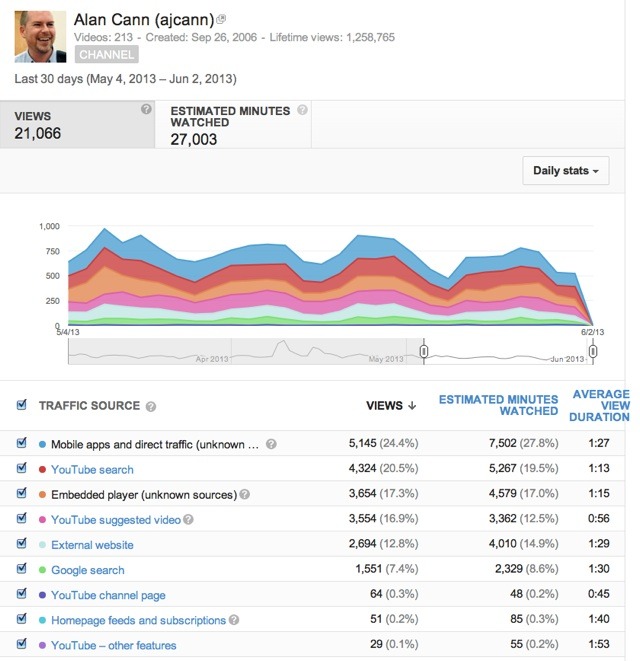
Mobile is top driver for video content - this is lean forward not sit back!
Lesson 2 was the hard sell for the controversial YouTube One Channel design.
Lesson 3 went all Apprentice with branding to sell physical stuff.
Marks for YTCA out of 10 so far? 6.
Monday, 3 June 2013

Four years on, the only blog post I've ever written here about oral sex remains by far the most popular content on this site....
Microbiology Today, the venerable quarterly magazine of the Society for General Microbiology, has a swanky new website (which is a huge improvement on previous iterations). The magazine itself has also had a makeover, and it now looks great:
Recently SGM took the decision to make MT online a "member benefit". For an organization dedicated to promoting microbiology to expend the time and effort producing something as good as Microbiology Today and then to lock it away so that only people who have already signed up can read it would be a stupid (although possibly understandable) decision. The idea that people will engage with a learned society because they will be able to read a magazine online a few weeks before they would otherwise be able to read it is implausible, unsupported by evidence, and possibly laughable.
Why locking this content away would be a stupid decision
SGM, like other learned societies, is not in the content business - it's in the society business. But seduced by decades of income from content publishing, learned societies have started to believe they are publishers rather than being dedicated to promoting their core interest - in this case, microbiology. If you want to understand why being in the content business is a dumb idea, read The Trouble With Content by Jeff Jarvis.
SGM, like other learned societies, is not a publisher, it is a platform. Unless it understands that and acts accordingly, it is doomed via the disintermediation of the Internet. Forget about raising income, unless the platform serves the interest, the future is bleak. Content is a product, it is not the interest that learned societies must serve.
So here's the good news. SGM has decided to make the superb content of Microbiology Today free to all at the time of publication, although only in PDF format. This is a smart move as it will recruit new members. The thing that is missing now is an explicit copyright statement to enable people who read the content know what they are able to do with it. By adopting a Creative Commons licence as forward looking publishers are increasingly doing, SGM gets the best of both worlds, publishing great content while acting like a society and engaging new members.
Disclosure:
I am a currently an elected member of the Society for General Microbiology Communications Committee, but the opinions expressed here are my own and do not represent those of the SGM or any other organization.
Recently SGM took the decision to make MT online a "member benefit". For an organization dedicated to promoting microbiology to expend the time and effort producing something as good as Microbiology Today and then to lock it away so that only people who have already signed up can read it would be a stupid (although possibly understandable) decision. The idea that people will engage with a learned society because they will be able to read a magazine online a few weeks before they would otherwise be able to read it is implausible, unsupported by evidence, and possibly laughable.
Why locking this content away would be a stupid decision
SGM, like other learned societies, is not in the content business - it's in the society business. But seduced by decades of income from content publishing, learned societies have started to believe they are publishers rather than being dedicated to promoting their core interest - in this case, microbiology. If you want to understand why being in the content business is a dumb idea, read The Trouble With Content by Jeff Jarvis.
SGM, like other learned societies, is not a publisher, it is a platform. Unless it understands that and acts accordingly, it is doomed via the disintermediation of the Internet. Forget about raising income, unless the platform serves the interest, the future is bleak. Content is a product, it is not the interest that learned societies must serve.
So here's the good news. SGM has decided to make the superb content of Microbiology Today free to all at the time of publication, although only in PDF format. This is a smart move as it will recruit new members. The thing that is missing now is an explicit copyright statement to enable people who read the content know what they are able to do with it. By adopting a Creative Commons licence as forward looking publishers are increasingly doing, SGM gets the best of both worlds, publishing great content while acting like a society and engaging new members.
Disclosure:
I am a currently an elected member of the Society for General Microbiology Communications Committee, but the opinions expressed here are my own and do not represent those of the SGM or any other organization.
Sunday, 2 June 2013

This is where I went on my holiday.
To be honest, I'm just testing the new version of the Blogger iOS app, which seems to have improved considerably since the first time I used it some months ago, but to be honest, I think I would struggle with anything other than short text posts or photoblogging (which it seems quite good for).
Subscribe to:
Posts (Atom)


